
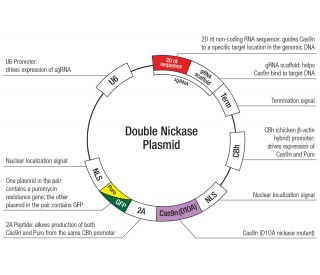
The Double Nickase Plasmid features a U6 promoter for sgRNA expression, a 20 nt targeting sequence, and a gRNA scaffold to guide Cas9n. It includes a CBh promoter for Cas9n (D10A) and puromycin resistance, GFP for transfection verification, and nuclear localization signals (NLS). The 2A peptide allows co-expression of Cas9n and Puro from a single promoter, enabling precise genome editing with reduced off-target effects.
Cas9n Nickase gRNA Plasmid Targeting: Dual gRNA plasmids create single-strand nicks at precise DNA sequences for efficient genome editing using Cas9n Nickase.
This image illustrates the Cas9n Nickase mechanism used for precise genome editing. Two plasmids (Plasmid 1 and Plasmid 2) are shown, each containing a targeted DNA sequence. The system utilizes single-guide RNAs (sgRNA) to direct Cas9n Nickase to specific genomic locations, represented by the blue and pink DNA strands. The sgRNA scaffold aids in guiding Cas9n to the 20 nucleotide (nt) target sequence on the DNA. Cas9n makes single-strand cuts at NCC and NGG sites, enabling precise gene modifications without creating double-strand breaks.
The Double Nickase Plasmid features a U6 promoter for sgRNA expression, a 20 nt targeting sequence, and a gRNA scaffold to guide Cas9n. It includes a CBh promoter for Cas9n (D10A) and puromycin resistance, GFP for transfection verification, and nuclear localization signals (NLS). The 2A peptide allows co-expression of Cas9n and Puro from a single promoter, enabling precise genome editing with reduced off-target effects.
白细胞介素α-胰蛋白酶抑制剂重链5(Inter-alpha-trypsin inhibitor heavy chain 5,ITIH5)是一种分泌型、与细胞外基质相关的蛋白质。它通过将重链以共价方式转移到透明质酸(hyaluronan)上,促进透明质酸的稳定并参与基质组织,从而影响组织的含水量与生物力学特性。在人类细胞中,ITIH5的功能与调控细胞-基质黏附、上皮完整性以及基质(间质)重塑的通路相交织,进而影响迁移、侵袭等过程。在多种组织背景中,ITIH5表达的改变与肿瘤生物学特征及转移潜能相关,这与其在细胞外基质稳态维持和细胞运动程序中的作用一致。这些特性使ITIH5成为解析富含透明质酸的基质如何塑造信号提示与细胞行为的有用靶点。
ITI-H5 双切酶质粒(h)由一对匹配的质粒组成,专为在 human 细胞系中对 ITIH5 位点进行高特异性编辑而设计。每个质粒分别表达Cas9 D10A切口酶和针对ITIH5内不同DNA链的独特sgRNA。当这两种切口酶被引导至相邻但位于DNA链相反侧的位点时,会产生错位的单链切口,从而共同形成错位双链断裂,这需要两个引导RNA在靶位点上协同发挥作用。由此产生的DNA断裂通过内源性细胞修复途径(最常见的是非同源末端连接(NHEJ))得到修复,从而导致插入或缺失,进而破坏ITIH5的功能。通过要求双sgRNA在靶位点结合,双切口方法提高了编辑特异性,并为需要对靶向精度进行额外控制的应用提供了互补的CRISPR策略。
